Stitched Into the Record: What Farmstead Quilts Reveal About Rural Economy, Loss, and Daily Life
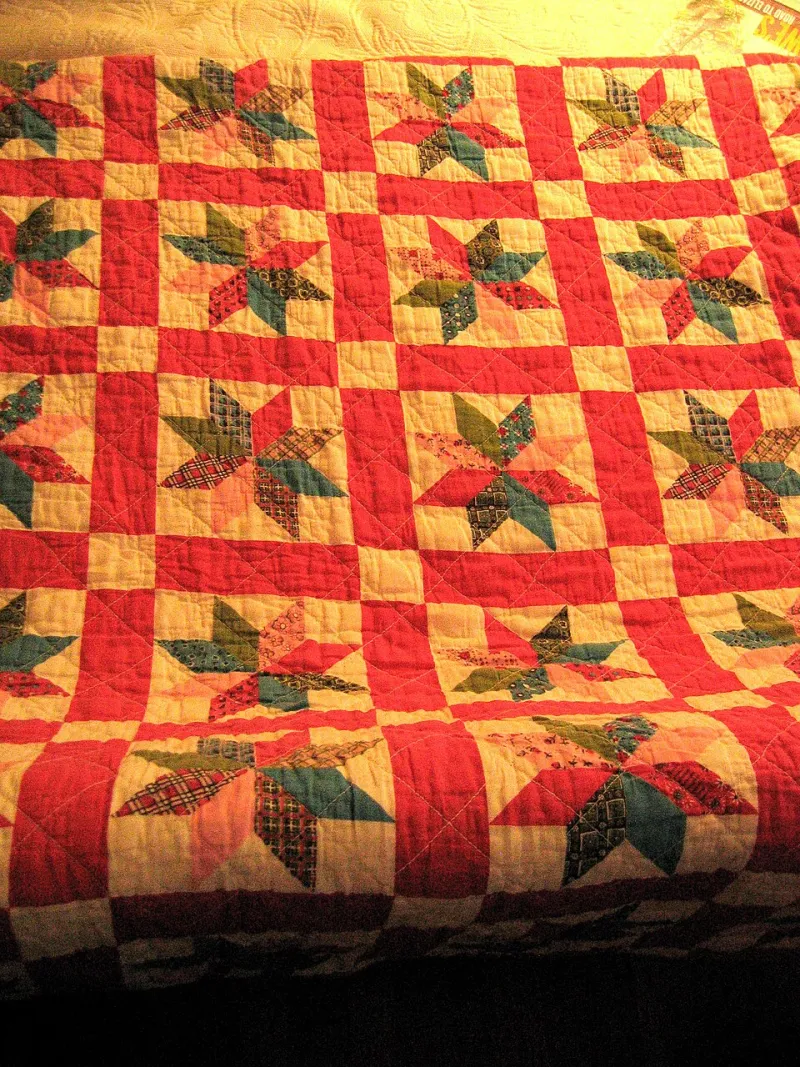
Photo: Brooke Raymond from kansas city, ks, usa, CC BY-SA 2.0, via Wikimedia Commons
Fabric as Document
Historians of rural America have long relied on the written record — the farm journal, the account ledger, the letter, the deed. These sources are invaluable, and the scholarship built upon them is substantial. Yet they capture only a portion of what rural life actually was. They tend to record transactions and decisions, the formal architecture of economic and social existence, while leaving largely undocumented the texture of daily experience — what people wore, what they valued, how they grieved, and how they made beauty from the materials at hand.
Quilts, by contrast, record all of these things. Made from fabric that was purchased, traded, received as gifts, cut from worn clothing, or salvaged from household goods, a farmstead quilt is a material autobiography of the household that produced it. Every fabric choice reflects an economic circumstance, a relationship with a merchant or neighbor, a decision about what could be spared and what could not. Every pattern reflects an aesthetic sensibility, a connection to a regional or ethnic tradition, or a deliberate act of creative expression within the constraints of available resources.
The surviving quilts of America's historic farmsteads — held in county historical societies, state museum collections, and private family hands from New England to the Pacific Northwest — constitute one of the richest and most underutilized archives of rural material culture available to historians and heritage researchers. Reading them requires a different set of skills than reading a ledger, but the rewards are proportionate to the effort.
The Economics of the Scrap Bag
The scrap bag — a repository of fabric remnants accumulated over time from dressmaking, clothing repair, and the repurposing of worn goods — was a fixture of the nineteenth- and early twentieth-century farmstead household. Its contents were not random. They reflected the household's purchasing patterns, its access to markets, and its position within local networks of exchange.
Textile historians who have examined large collections of American quilts have identified consistent patterns in fabric sourcing that correspond to documented economic conditions. Quilts made on Midwestern farmsteads in the 1870s and 1880s, for example, frequently incorporate fabrics that were available through the expanding network of rural general stores and early mail-order catalogs — a material signature of the period's improving market integration. The distinctive double-pink and chrome-orange prints that appear in quilts from this era were produced by specific American textile mills and distributed through identifiable commercial channels.
Conversely, quilts made during periods of economic contraction — the depression years of the 1890s, the agricultural crisis of the 1920s, and especially the Great Depression of the 1930s — show a marked shift toward the use of feedsacks, flour bags, and other recycled commercial packaging as fabric sources. The feedsack quilt, far from being merely a charming expression of Yankee thrift, is a precise economic indicator: its presence in a household's textile record documents a moment when commercial fabric became financially inaccessible and domestic ingenuity was the only available substitute.
This reading of quilts as economic documents requires familiarity with textile history — with the dates of specific fabric prints, the distribution patterns of particular manufacturers, and the commercial geography of rural retail. But for those equipped with this knowledge, a single quilt can yield information about a household's economic circumstances that no surviving ledger might provide.
Patterns and Their Meanings
The names given to quilt patterns in nineteenth-century rural America constitute a vernacular geography of the farmstead world. Bear's Paw, Flying Geese, Log Cabin, Double Wedding Ring, Grandmother's Flower Garden — these are not merely decorative designations. They are references to the material and emotional landscape of rural life, encoded in geometric form.
Regional variation in pattern preference has been documented extensively by textile scholars, and it maps onto the cultural geography of American settlement with remarkable fidelity. The strong tradition of Hawaiian quilting, with its bold, symmetrical appliqué designs derived from both indigenous and missionary influences, is distinct from the pieced geometric traditions of the Appalachian highlands, which are in turn different from the elaborate broderie perse and medallion quilts associated with prosperous mid-Atlantic farm households of the Federal period.
Within these regional traditions, individual families and communities developed their own pattern vocabularies. Church communities sometimes adopted shared patterns for fundraising quilts. Ethnic communities — German settlements in Pennsylvania and Texas, Scandinavian communities in the upper Midwest, Dutch Reformed settlements in Michigan — often maintained textile traditions that connected them to their places of origin while adapting to American materials and conditions.
For the heritage researcher, pattern identification is only the beginning. The more revealing questions concern why a particular pattern was chosen, who made that choice, and what it communicated to the community of people who would have seen and used the finished object.
Grief Stitched in Silk and Wool
Among the most historically significant categories of American farmstead quilts are those made in connection with death and collective mourning. Memorial quilts — objects incorporating fabric from the clothing of deceased family members — were produced across the United States throughout the nineteenth century, and surviving examples document the intimate relationship between textile production and the processing of grief in rural communities.
These quilts were not sentimental in the modern, decorative sense of that word. They were functional objects that served a specific cultural purpose: the transformation of a person's material presence — their worn clothing, their household textiles — into a new object that could be used, displayed, and transmitted to future generations. A quilt made from a father's work shirts and a mother's Sunday dress is, in this sense, a form of ancestor preservation, a material genealogy that operates outside the written record.
Friendship quilts — made collaboratively by a community of women as gifts for a departing neighbor, a newly married couple, or a minister leaving a congregation — served a related but distinct function. Each block, signed by its maker, constitutes a record of a social network at a specific moment in time. These objects have been used by genealogical researchers to reconstruct the membership of rural communities, identify migration patterns, and document the networks of mutual support that sustained farm families through periods of difficulty.
Museum collections in states including Ohio, Pennsylvania, and Indiana hold significant numbers of signed friendship quilts from the nineteenth century, and the names inscribed on their blocks have been cross-referenced with census records, church membership lists, and land records to produce detailed reconstructions of specific rural communities.
Mending as Memory
Perhaps the most overlooked dimension of quilt history is the evidence contained not in the original construction of a quilt but in its subsequent repair. The mending history of a surviving quilt — the patches applied over damaged areas, the restitching of worn seams, the replacement of deteriorated backing fabric — constitutes a chronological record of the object's use across generations.
Conservators who have examined historic quilts with this question in mind have found that mending practices themselves carry historical information. The fabrics used in patches can be dated, allowing researchers to establish approximate timelines for when a quilt was repaired and, by inference, how heavily it was used. A quilt that was repeatedly mended across several decades was a valued household object, passed down through generations and maintained at some cost of labor and material. A quilt that was never mended may have been reserved for display or ceremonial use, revealing a different set of priorities.
For heritage travelers who encounter quilts in the context of historic farmstead interpretation, the invitation is to look not only at the beauty of the original design but at the evidence of use and repair that accumulates over a long domestic life. These are not static objects. They are living documents, altered and annotated by every generation that used and maintained them — a quality that makes them, in their own way, as rich and as complicated as any written record the farmstead produced.