From the Garden to the Cookstove: The Vanished Kitchen Culture of America's Rural One-Room Schools
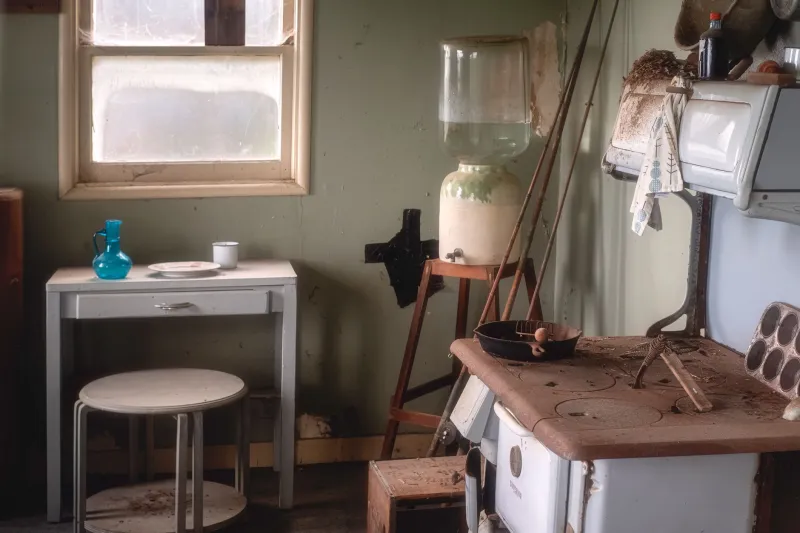
In the winter months, the smell of something cooking reached the schoolroom long before the noon hour. A pot of bean soup, perhaps, or a pan of cornbread set near the stove to warm. The teacher might have started it before the children arrived. One of the older girls would have tended it through the morning lessons. By the time the younger students were released for the midday break, a meal drawn almost entirely from local farms and kitchen gardens was ready to serve.
This was the ordinary reality of the rural one-room schoolhouse kitchen — a space that has received far less historical attention than the blackboards and McGuffey Readers with which it shared a building. Yet for the farm communities of the nineteenth and early twentieth centuries, the schoolhouse kitchen was something remarkable: a place where the knowledge of the land was taught as deliberately as arithmetic, where cooking was understood to be both a domestic skill and an agricultural one, and where the school itself served as a kind of community hearth.
Origins of a Functional Tradition
The earliest rural schoolhouses in America were built with survival in mind. Heating was the primary concern, and the cast-iron stove that dominated most one-room school interiors served double duty as both furnace and cooking apparatus. In the colder regions of New England, the upper Midwest, and Appalachia, children who walked considerable distances to school in winter needed something warm to eat at midday. The school stove was the obvious solution.
By the latter half of the nineteenth century, as school terms lengthened and state education departments began issuing more formal guidance on schoolhouse design, the cooking function was gradually formalized. Some districts constructed modest additions to their schoolhouses specifically to house a cooking area, complete with a second stove, a worktable, and storage for dry goods. In other cases, a portion of the main schoolroom was simply designated for food preparation, with shelving, a basin, and the necessary utensils occupying one corner of the building.
The connection to local agriculture was not incidental — it was structural. Most rural school districts operated on tight budgets, and the expectation that students would bring contributions from their families' farms was embedded in the culture of the institution. Families sent what they had: jars of preserved vegetables, dried beans, salt pork, potatoes from the root cellar, eggs wrapped in straw. The school kitchen was, in a very real sense, an extension of the farm economy.
Domestic Economy as Agricultural Education
The curriculum that surrounded the schoolhouse kitchen was known in the late nineteenth century as domestic economy, and later as home economics. Its inclusion in rural school programs reflected a philosophy that treated the management of a farm household as a subject worthy of formal instruction. Girls were its primary students, though in many schools boys participated in related lessons on kitchen gardening and food preservation.
What distinguished the rural version of this curriculum from its urban counterpart was its insistence on working with what the local land produced. Urban home economics instruction often relied on standardized commercial ingredients. In the one-room school, the lesson was shaped by the season. Students learned to cook with early spring greens before root vegetables were available, to preserve the summer harvest before the first frost, to stretch dried and salted provisions through the long months of winter.
Recipe collections from rural school districts of this era, where they survive, reveal a cooking tradition closely tied to regional agricultural patterns. Schools in the corn-belt states taught the preparation of hominy, cornmeal mush, and dried corn soups. Schools in the dairy regions of Wisconsin and upstate New York incorporated butter-making and simple cheese preparation. Schools in the fruit-growing districts of the mid-Atlantic states taught canning and preserving as formal skills, with the school's own kitchen garden supplying the raw materials.
The Iowa State Agricultural College Extension Service, which worked closely with rural school districts in the early twentieth century, documented dozens of such programs in its published reports. Extension agents noted with some admiration that the best rural school kitchens maintained their own small gardens, grew herbs for seasoning, and in some cases kept chickens or a beehive on the school grounds.
The Schoolhouse Kitchen as Community Space
Beyond its role in formal instruction, the rural schoolhouse kitchen served a community function that is difficult to overstate. In farm districts where households were separated by miles of unpaved road, the school was often the only gathering place available for regular community events. The kitchen made those events possible.
School suppers, box socials, harvest dinners, and holiday celebrations were organized around the schoolhouse kitchen's capacity. Women from surrounding farms brought their best dishes; the school's stove and worktables provided the infrastructure for preparation and serving. These gatherings were both social and economic in character — a means of reinforcing community bonds, exchanging agricultural information, and negotiating the informal relationships that governed rural life.
The school kitchen was also a site of intergenerational knowledge transfer that operated outside the formal curriculum. Mothers who came to help with school dinners cooked alongside their daughters. Grandmothers who had learned to preserve food in the decades before commercial canning equipment became widely available passed their methods to younger women in the school kitchen's informal atmosphere. The recipes that circulated through these gatherings were rarely written down; they traveled by demonstration and repetition.
Consolidation and the Closing of the Kitchen
The consolidation movement that swept through American rural education in the decades following World War II brought an end to the one-room schoolhouse and, with it, the kitchen culture that had grown up around it. Between 1940 and 1970, the number of one-room schools in the United States fell from approximately 113,000 to fewer than 2,000. Children who had previously walked or ridden to a small local school were bused to larger consolidated facilities in nearby towns.
The consolidated school cafeteria was a different institution entirely. Designed for efficiency and standardization, it operated on a model that had no relationship to local agriculture. Food arrived from regional distributors, was prepared by professional kitchen staff, and was served to hundreds of children at once. The connection between what grew in the surrounding fields and what appeared on the lunch tray was effectively severed.
The loss extended beyond the kitchen itself. When the one-room school closed, the community gathering function it had served disappeared as well. The school suppers and harvest dinners that had bound farm families together no longer had a home. Some communities attempted to replicate these traditions in church halls or grange buildings, but the institutional continuity was broken.
What Survives, and What It Tells Us
A small number of restored one-room schoolhouses across the country have made deliberate efforts to recover and interpret the kitchen traditions of their buildings. Living history programs at sites in Ohio, Minnesota, and Virginia have reconstructed period cooking demonstrations, working from surviving recipe collections, extension service records, and the memories of elderly residents who attended such schools in their youth.
These programs offer something that conventional agricultural history rarely provides: a sensory connection to the past. The smell of a pot of beans simmering on a wood-burning stove in a December schoolroom communicates the texture of rural life in ways that no written account fully replicates. Visitors who participate in these demonstrations frequently report that the experience reframes their understanding of what farm education actually meant — that it was never only about books, but about equipping young people to sustain themselves and their communities from the land they inhabited.
The schoolhouse kitchen was a small room. What it held was considerably larger.