Temporary Ground, Permanent Marks: The Built Environments of America's Migrant Farm Communities
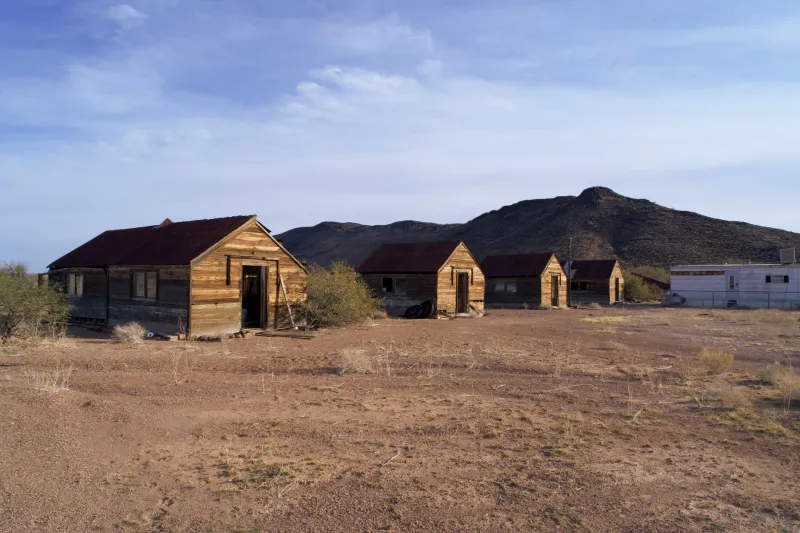
In the flat fields east of Stockton, California, there is a labor camp that no longer exists. The wooden barracks were demolished in the 1960s. The community garden was plowed under. The small wooden structure that served as a chapel—built by Filipino workers who had spent their savings on lumber and corrugated metal roofing—was burned to clear the site. What remains is a concrete slab, a drainage ditch, and, in the records of the San Joaquin County Assessor's Office, a property description that notes, without elaboration, "former agricultural labor housing."
This kind of erasure is not exceptional. It is the rule. Across the agricultural regions of the United States—the Central Valley of California, the Rio Grande Valley of Texas, the truck-farming districts of New Jersey and the Delmarva Peninsula, the sugar beet fields of Colorado and Michigan—the physical environments created by generations of migrant farm workers have been almost entirely destroyed. What survives does so largely by accident: a surviving photograph, a hand-drawn map in a federal agency file, a memory held by someone now in their eighties.
The scholarly effort to recover and interpret these environments is, by necessity, a discipline of fragments.
The Architecture of the Harvest Circuit
Migrant agricultural labor in the United States has never been a single phenomenon. It has encompassed successive and overlapping waves of workers—Chinese and Japanese laborers in the nineteenth-century West, Mexican and Mexican American workers whose presence intensified after the disruptions of the Mexican Revolution, African American workers moving through the eastern seaboard's fruit and vegetable districts, Filipino and Puerto Rican workers whose migration patterns were shaped by specific colonial and economic relationships with the United States. Each of these groups brought distinct cultural traditions to the built environments they created, and each operated within a different set of constraints imposed by landowners, labor contractors, and local governments.
The most basic unit of migrant settlement was worker housing, and its quality ranged from the barely habitable to the genuinely degrading. Federal surveys conducted by the Farm Security Administration in the late 1930s documented conditions in labor camps across the country with a thoroughness that was, in part, politically motivated—the New Deal administration was building a case for federal intervention in agricultural labor conditions—but that produced an archival record of extraordinary value. The photographs taken by FSA photographers such as Dorothea Lange and Russell Lee have become iconic. Less well known are the written surveys, architectural drawings, and site plans that accompanied them, many of which are now held at the Library of Congress.
Those documents reveal that even within the worst conditions, workers modified their environments in ways that expressed cultural identity and asserted human dignity. Gardens appeared in the margins of camp lots. Religious images were fixed to barrack walls. Spaces were reorganized to accommodate communal cooking practices that differed from the individual-unit model the camp designers had assumed. These modifications were rarely permanent—they moved with the workers—but they were consistent and intentional.
Community Spaces and Cultural Expression
Beyond individual housing, migrant communities created shared spaces that served functions the labor camp infrastructure was never designed to accommodate. Makeshift chapels, often built by workers on their own time using salvaged or purchased materials, appeared in camps throughout the Southwest and California. In the bracero program camps of the 1940s and 1950s—where Mexican workers were housed under a federal guest worker arrangement that brought several hundred thousand men to American farms annually—small shrines to the Virgin of Guadalupe were constructed with a regularity that camp administrators noted, sometimes with irritation, in their management records.
Community kitchens and gathering spaces served equally important social functions. In the Filipino labor camps of the Salinas Valley, workers who had come from specific regions of the Philippines maintained distinct community identities within the larger camp population, organizing around shared regional cuisine and mutual aid networks. The spaces they used for these purposes—a corner of a barrack, a cleared area beneath a stand of trees, an improvised outdoor cooking station—were not architectural in any formal sense, but they performed architectural work: they defined territory, structured social interaction, and made a temporary place feel, however briefly, like a community.
In the African American labor camps of the eastern seaboard, the church—sometimes a building, sometimes simply a designated space—provided a cultural anchor that connected the migrant experience to a broader tradition of Black community formation. Oral histories collected by researchers at the University of Maryland and the Virginia Foundation for the Humanities describe the ways in which religious practice organized time and space within the harvest circuit, creating a structure of meaning that persisted regardless of the physical impermanence of the camps themselves.
Why So Little Survives
The near-total physical disappearance of migrant worker settlements is not simply the result of time and weather. It reflects a set of deliberate choices—by landowners, by local governments, and by the broader society—about whose built environments were worth preserving.
Labor camp structures were designed to be temporary because their owners had no interest in making them permanent. When a camp was no longer economically useful—when mechanization replaced the workers who had occupied it, or when changing agricultural patterns shifted the labor demand elsewhere—the buildings were demolished or allowed to deteriorate without any consideration of their historical significance. The workers who had lived in them had no property rights to assert and, in most cases, no political standing to demand preservation.
The contrast with the treatment of farmstead architecture associated with farm owners is instructive. Historic barns, farmhouses, and agricultural outbuildings associated with landholding families have been the subject of systematic preservation efforts for decades. National Register nominations, state historic preservation programs, and local heritage organizations have invested substantial resources in documenting and protecting these structures. The physical environments of the workers who made those farms productive have received, by comparison, almost no institutional attention.
This disparity is beginning to attract critical scrutiny. Scholars working at the intersection of architectural history, labor history, and ethnic studies have begun arguing that the preservation of agricultural heritage is incomplete—and, in a meaningful sense, dishonest—if it documents only the environments of ownership while ignoring those of labor.
Reading What Remains
For researchers working in this field, the challenge is to extract maximum interpretive value from minimal physical evidence. LiDAR surveys of former camp sites have identified subsurface features—foundations, drainage systems, the compacted soil of former pathways—that are invisible at ground level. Archaeological investigations at several former California labor camp sites have recovered material culture that documents daily life with a specificity that no written record can match.
Oral history remains indispensable. The generation of workers who lived in the labor camps of the 1940s, 1950s, and 1960s is aging rapidly, and the knowledge they carry—of specific places, specific buildings, specific communities—is irreplaceable. Projects such as the Farmworker Movement Documentation Project, founded by LeRoy Chatfield, have preserved thousands of pages of testimony and hundreds of photographs that constitute a primary archive for this history.
For heritage tourism, the implications of this scholarship are significant. Agricultural heritage sites that acknowledge only the landowner's story present a version of rural history that is, at best, partial. The farms that produced America's food were worked by people whose lives, cultures, and built environments deserve documentation and interpretation alongside the barns and farmhouses that have long received institutional attention. Recovering those environments—even in fragmentary form—is not simply an act of historical correction. It is a recognition that the land remembers everyone who worked it, not only those who held the deed.