Between Pulpit and Plow: The Forgotten World of America's Ministerial Farms
A Calling That Extended to the Fields
In the popular imagination, the rural minister of the eighteenth and nineteenth centuries is a figure of the pulpit — a man of words, of scripture, of Sunday mornings. Yet for a remarkable number of America's frontier and small-town clergy, the week's labor looked considerably less ethereal. They rose before dawn to tend livestock. They negotiated the price of rye at the local mill. They kept careful records of seed purchases alongside baptismal registers, and they understood that the survival of their congregation was inseparable from the productivity of the land beneath the parsonage.
The ministerial farm — sometimes called the glebe farm in traditions inherited from English Anglican practice — was not a curiosity of the early colonial period but a sustained and widespread institution that persisted well into the late nineteenth century across denominations as varied as Lutheran, Methodist, Presbyterian, and Reformed congregations. In communities where cash was scarce and parishioners could offer little more than grain, cordwood, or labor in lieu of salary, the minister's ability to work his own acreage was often the difference between a congregation retaining its shepherd and losing him to a more prosperous parish.
The Economics of the Parsonage Acre
Church records preserved in denominational archives offer surprisingly granular documentation of how these properties functioned as economic systems. A Lutheran congregation in central Pennsylvania, for instance, recorded in its 1847 vestry minutes that the resident pastor was allocated fourteen acres of cleared land, a kitchen garden plot, and the right to graze two milk cows on the church commons — all understood as compensation supplements when the annual subscription among congregants fell short of the agreed stipend.
This was not charity but contract. Denominational manuals from the mid-nineteenth century, particularly among German Reformed and Lutheran bodies concentrated in Pennsylvania, Ohio, and the upper Midwest, frequently specified the acreage and soil quality that a parsonage property should carry. The expectation was explicit: a minister with good land could weather years of thin congregational giving without abandoning his post. The farm was, in effect, an institutional hedge against the economic volatility of rural life.
Methodist circuit riders faced a different but related calculus. Because many itinerant Methodist ministers traveled between multiple preaching stations, the parsonage farm was often managed by the minister's wife and older children in his absence — a domestic agricultural arrangement that placed extraordinary demands on clerical families while simultaneously grounding the congregation's pastoral leadership in the rhythms of the agricultural calendar.
Theology Written in Soil
What distinguishes the ministerial farm from an ordinary agricultural holding is the degree to which theological conviction shaped its management. Church records and the surviving diaries of rural clergy reveal that many ministers understood their farming practices as extensions of their spiritual witness. The well-ordered farm — its fences maintained, its fields properly rotated, its animals humanely kept — was presented to congregants as a visible argument for the moral order the minister preached on Sundays.
Several German Lutheran and Reformed ministers of the early nineteenth century wrote explicitly about this connection in their correspondence with denominational bodies. One Pennsylvania pastor, writing to his synod in 1831, described his decision to introduce a new variety of winter wheat on the parsonage land as a form of practical evangelism: if neighboring farmers could observe the improved yields from his fields, they might adopt the same methods, and the congregation's collective prosperity would follow. The minister, in this framing, was not merely a spiritual guide but an agricultural demonstrator — a role that would later be formalized in the extension service movement but that existed informally in clerical communities for generations prior.
Among some pietist communities, the connection between land stewardship and theological obligation was even more direct. The Brethren and Mennonite traditions, with their deep suspicion of idleness and their communal ethic of mutual provision, produced ministerial farmers who were expected to labor visibly alongside their congregants, making no distinction between the dignity of preaching and the dignity of plowing.
The Architecture of the Dual Life
The physical structures of the parsonage farm reflected its dual purpose with remarkable consistency across regions. Surviving examples — and a surprising number do remain, often absorbed into larger farm complexes or converted to residential use — typically feature a modest but well-proportioned dwelling attached or closely adjacent to a functional barn, with the kitchen garden positioned between the two structures as a kind of mediating space.
In New England Congregational communities, the minister's house was frequently the most architecturally deliberate structure in the village, a statement of denominational stability and civic permanence. Yet even in these settings, the outbuildings tell a different story: utilitarian, pragmatic, oriented toward production rather than display. The tension between the minister's public role as a figure of learning and refinement and his private necessity as a working farmer is legible in the built record.
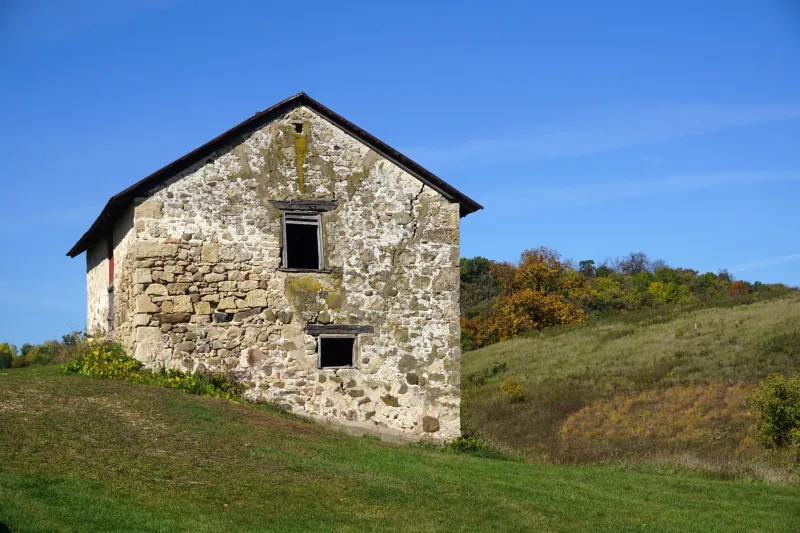
In the German Lutheran communities of the mid-Atlantic and Midwest, the parsonage farm often bore a closer visual resemblance to the neighboring farmsteads than to any ecclesiastical ideal. Fieldstone construction, banked barns, and root cellars appear with the same frequency on ministerial properties as on lay farms of comparable size — a reminder that in these communities, the minister was understood first as a member of the farming community and only secondarily as a figure of institutional authority.
Decline and Disappearance
The ministerial farm as an institution began its long decline in the decades following the Civil War, as rural economies were gradually monetized, denominational salary structures were standardized, and the cultural prestige of farming labor diminished relative to professional life. By the early twentieth century, most denominations had moved toward cash compensation models that rendered the parsonage farm unnecessary, and the acreage that had once been cultivated by generations of clerical farmers was sold, subdivided, or simply allowed to revert to woodland.
The loss was not only economic but cultural. With the ministerial farm went a particular model of pastoral leadership — one grounded in physical labor, seasonal vulnerability, and the intimate knowledge of what it meant to depend on rain and soil for survival. That knowledge had made many rural ministers unusually effective interpreters of their congregants' lives. Its disappearance quietly widened the distance between pulpit and pew in ways that were rarely acknowledged at the time.
Recovering a Neglected Heritage
For heritage researchers and agritourism enthusiasts, the parsonage farm represents an underexplored category of historic rural property. Denominational archives — many of which remain poorly indexed and underutilized — hold vestry minutes, property inventories, and ministerial correspondence that can reconstruct the agricultural histories of these sites in considerable detail. Land deeds recorded at county courthouses frequently identify former parsonage acreage, and the persistence of old-growth orchard trees or unusual field configurations can sometimes identify a ministerial property on the landscape even when documentary evidence is thin.
Several historic sites across Pennsylvania, Virginia, and the upper Midwest have begun incorporating the agricultural histories of their associated parsonage properties into interpretive programming, recognizing that the full story of rural religious life cannot be told without accounting for the soil that sustained it. The minister at the plow is not a figure of contradiction but of wholeness — a man whose faith was, in the most literal sense, rooted in the land.