Chalk, Primer, and Prairie Wind: The One-Room Schoolhouse as the Cornerstone of America's Farm Country
A Building for Every Township
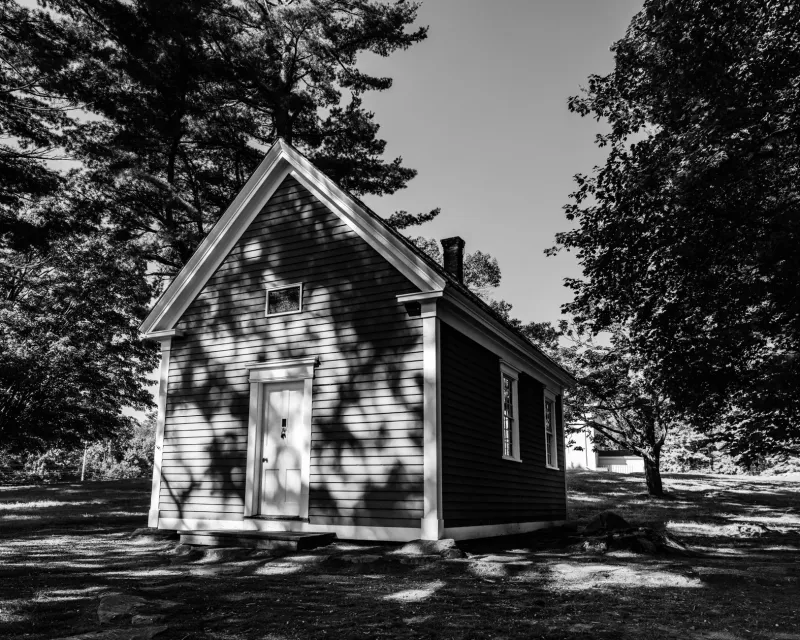
Drive the back roads of the Midwest long enough and you will eventually encounter one — a small, weathered frame building sitting alone at the edge of a cultivated field, its bell tower intact or long since collapsed, its windows boarded or simply gone. The one-room schoolhouse is one of the most recognizable silhouettes in the American rural landscape, yet its full significance is rarely appreciated by those who pass it today. For the farm communities that built these structures throughout the nineteenth and early twentieth centuries, the schoolhouse was not a convenience. It was a declaration.
At the height of American agricultural expansion, rural school districts multiplied with remarkable speed. By 1910, the United States counted more than 200,000 one-room schoolhouses in operation, the vast majority of them embedded within farming regions stretching from Ohio to Oregon. Their placement was rarely accidental. Most were situated along section lines — the surveyed boundaries that divided agricultural land into orderly parcels — so that children from neighboring farms could reach them within a reasonable walking distance. Geography, in this sense, was pedagogy. The landscape itself was organized around the act of learning.
Modest Architecture, Deliberate Design
The buildings themselves were rarely elaborate, and that restraint was intentional. Farm families who contributed labor, lumber, and dollars to their construction understood that every resource spent on ornamentation was a resource diverted from the land. Yet within their simplicity, one-room schoolhouses followed a surprisingly consistent architectural grammar that reflected genuine pedagogical thinking.
A single large room — typically measuring between twenty and thirty feet in length — provided space for students ranging from the youngest beginners to adolescents preparing for high school entry. Large windows, positioned along the south and east walls whenever possible, admitted natural light across the writing surfaces of students without creating glare. A raised platform at the front of the room elevated the teacher's desk, reinforcing the authority of instruction while also allowing a single educator to maintain visual oversight of every pupil simultaneously. A central woodstove, often donated by a local merchant or landowner, provided heat that was never quite evenly distributed, a fact that older students who sat farthest from the fire remembered well into adulthood.
Entryways frequently included a small vestibule — sometimes called the cloakroom — where students hung coats, stored lunch pails, and shed muddy boots before entering the instructional space. This transitional zone was more than practical. It marked the boundary between the outdoor world of farm labor and the interior world of academic discipline, a threshold that children crossed twice daily and that carried genuine symbolic weight in communities where education represented a form of aspiration.
The Material Culture of Learning on the Land
The objects that filled these schoolrooms tell their own layered story. Slates and chalk gave way over time to paper tablets and pencils, marking the gradual integration of rural communities into broader commercial networks. Primers and readers — McGuffey's Eclectic Readers being among the most ubiquitous — circulated through families for years, their margins annotated by successive generations of siblings and cousins. Maps pinned to the walls depicted a nation still expanding, their political boundaries shifting edition by edition as territories became states.
What the material record reveals most clearly is the tension between scarcity and aspiration that defined farm educational culture. Books were precious and carefully maintained. Ink wells were refilled with care. The school bell, whether cast iron or simply a hand-held instrument, marked time in a community where time was measured in harvests and planting seasons as much as in academic calendars. The school year itself was calibrated to agricultural rhythms — shortened in spring planting season and autumn harvest, extended slightly during the quieter winter months when children's labor was less urgently required in the fields.
The Schoolhouse as Social Anchor
To understand the one-room schoolhouse only as an educational institution is to misread its role in farm community life. These buildings functioned as multipurpose civic spaces in regions where no other public gathering place existed. On weekday mornings they were classrooms. On Friday evenings they became venues for spelling bees, literary societies, and debates. On Sundays, in communities without a nearby church, they served as places of worship. During elections, they functioned as polling stations. When a community needed to organize — around a road improvement, a drainage dispute, or a mutual aid effort — the schoolhouse was where neighbors assembled.
This social centrality made the schoolhouse a site of community identity in a way that transcended its educational function. A township's investment in its school building was, in a meaningful sense, a statement about what kind of community it intended to be. Families who had emigrated from Scandinavia, Germany, or the British Isles brought with them strong cultural convictions about the relationship between literacy and respectability, and those convictions found physical expression in the quality of the structure they erected. Some communities, even under conditions of genuine financial hardship, insisted on brick construction, decorative cornices, or proper bell towers — not as vanity, but as evidence of permanence and seriousness.
What Survives, and What It Costs to Keep It
The consolidation of rural school districts, which accelerated dramatically after World War II, rendered the one-room schoolhouse obsolete almost overnight. Improved roads, school buses, and state policies favoring larger centralized institutions emptied these buildings of their original purpose within a single generation. Many were sold to neighboring farmers and converted to storage. Others were simply abandoned to the slow work of weather and time. A fortunate few were relocated to county fairgrounds or museum properties, where they have been preserved as static exhibits.
The most compelling preservation efforts, however, are those that have returned these structures to something resembling active community use. Across states including Kansas, Nebraska, Iowa, and Minnesota, local historical societies and heritage organizations have stabilized surviving schoolhouses and opened them for guided interpretation, living history programming, and educational outreach. Some host annual sessions where children experience a simulated school day under nineteenth-century conditions — working from period primers, practicing penmanship on slates, and learning arithmetic through the recitation methods that once echoed off these same plank walls.
The physical challenges of preservation are considerable. Many surviving structures suffer from foundation deterioration, roof failure, and the accumulated damage of decades without maintenance. Grant funding through state historic preservation offices and federal programs such as the Historic Preservation Fund has supported restoration work in numerous cases, though demand consistently outpaces available resources.
Reading the Landscape Again
For the heritage traveler moving through America's agricultural heartland, the one-room schoolhouse offers something that no museum reproduction can fully replicate — the experience of encountering history in the exact place where it occurred. To stand in one of these buildings at the edge of a working cornfield, to feel the particular quality of light through its old glass windows, and to imagine the voices of farm children conjugating verbs or reciting geography while the wind moves through the surrounding fields, is to understand something essential about the relationship between learning and land in American life.
These structures were not built apart from the agricultural landscape. They were built within it, for it, and by the people who worked it. Their survival is not merely an architectural or historical matter. It is a question of whether future generations will have access to one of the most honest expressions of what rural American communities once believed about themselves and about the future they were trying to build, one school term at a time.