Where the Furrows Faded: Reading the Silence of America's Abandoned Farmlands
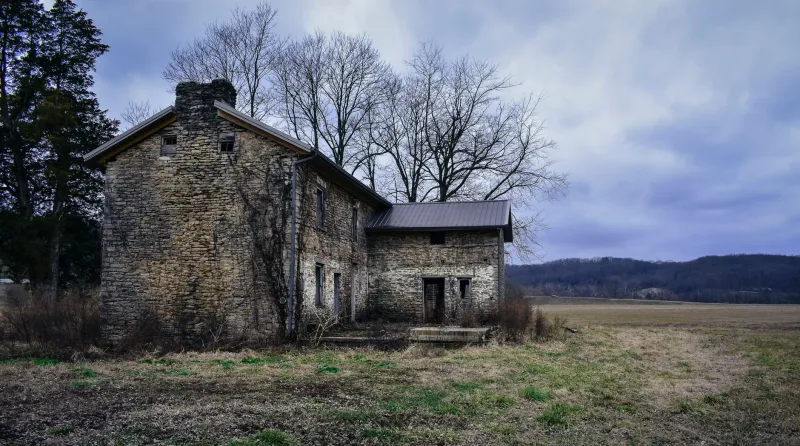
The Land That Outlasted Its Farmers
Drive far enough down almost any rural road in the American Northeast, the Appalachian highlands, or the cutover regions of the upper Midwest, and the forest will eventually begin to tell a different story than the one it appears to tell. Among the second-growth trees, patient observers will find them: the sunken depressions of old root cellars, the geometric shadow of stone walls running through woodland that was once open pasture, the faint corrugations in the earth where rows of corn or wheat once stood in the sun. These are the ghost fields — the remnants of a vast agricultural civilization that once covered tens of millions of American acres and then, with remarkable speed and thoroughness, simply ceased to be.
They are not ruins in the dramatic sense. There are no crumbling columns or toppled monuments. The abandonment of American farmland is quieter than that, and in many ways more profound. The land simply closed over itself, reclaiming in decades what families had cleared over generations. Understanding why — and what that process reveals about the arc of rural American life — has become one of the more compelling challenges in contemporary landscape history and agricultural preservation.
A Retreat Written in Stone and Soil
The physical evidence left behind in abandoned agricultural landscapes is, to a trained eye, remarkably expressive. Landscape archaeologists and historical geographers have developed sophisticated methods for reading what they call "relict features" — the structural and topographic traces of former land use that persist long after the people who created them have gone.
Stone walls are among the most durable witnesses. In New England alone, an estimated 100,000 miles of stone walls thread through what is now forested land, constructed by farmers who cleared glacial till from their fields over the course of the eighteenth and nineteenth centuries. Their presence in the middle of dense woodland is disorienting at first, but deeply informative: they mark the boundaries of pastures and crop fields that were active, in many cases, within living memory of the oldest generation still alive today.
Soil itself holds evidence. Agricultural soils, enriched by decades of manuring and tillage, retain a distinct chemical and structural signature that persists for centuries. Researchers using soil coring, LiDAR aerial mapping, and ground-penetrating radar have been able to reconstruct the layout of vanished farms with striking precision — identifying not only field boundaries, but the locations of outbuildings, garden plots, orchard rows, and drainage ditches that have long since disappeared from the surface.
The Forces That Emptied the Fields
No single cause accounts for the scale of American agricultural abandonment. The process unfolded across different regions at different times, driven by overlapping pressures that were economic, environmental, climatic, and deeply human in character.
In New England, the opening of the Erie Canal in 1825 and the subsequent westward expansion of agricultural settlement dealt a blow to marginal hill farms from which they never recovered. Farmers working thin, rocky soils in Vermont or western Massachusetts simply could not compete with the fertile flatlands of Ohio, Indiana, and Illinois, where a single family could cultivate acreage that would have been unimaginable back east. By the late nineteenth century, the exodus was well underway, and by the mid-twentieth century, vast swaths of formerly farmed New England landscape had returned to forest.
In Appalachia, the pattern was shaped by a different set of forces. The extractive economy of coal and timber drew labor away from subsistence farming, and when those industries contracted, the communities that had grown up around them collapsed as well, leaving behind not only abandoned mines and mill sites but the agricultural landscapes that had sustained workers between industrial seasons. The marginal farms of the southern highlands — never prosperous by any measure — were among the first to go.
The Great Plains tell yet another story, one written in drought and debt. The Dust Bowl catastrophe of the 1930s accelerated the abandonment of dryland farms across Kansas, Oklahoma, Colorado, and the Texas Panhandle that had been struggling since the commodity price collapses of the 1920s. Many of those fields were never replowed. Some were absorbed into larger operations; others reverted to grassland or were enrolled in federal conservation programs. Their traces — the remnants of homestead shelterbelt plantings, the foundations of abandoned farmhouses, the faint grid of section-line roads leading to nowhere — remain visible across the high plains landscape.
What the Ghost Fields Are Teaching Us
For contemporary researchers, abandoned agricultural landscapes are not merely sites of loss. They are, increasingly, understood as ecological and historical resources of considerable value — and as cautionary texts that speak directly to present-day questions about rural sustainability, land use policy, and the future of American agriculture.
Ecologically, former farmland in various stages of reforestation provides important habitat for a range of plant and animal species, and in some regions has contributed meaningfully to carbon sequestration. Land conservancies in New England, the mid-Atlantic states, and parts of the Southeast have prioritized the protection of these transitional landscapes precisely because of their ecological complexity.
Historically, the study of ghost fields has deepened our understanding of the relationship between agricultural viability and broader social stability. Researchers at several land-grant universities have been mapping the correspondence between farm abandonment and the decline of rural institutions — schools, churches, general stores, and local governments — finding that the loss of agricultural activity rarely occurs in isolation. When the farms go, the communities that depended on them follow with troubling speed.
This insight carries direct relevance for preservation advocates working in regions currently experiencing agricultural stress. The ghost fields of New England and Appalachia are not historical curiosities; they are precedents. The economic pressures that emptied those landscapes — consolidation, commodity price volatility, the departure of younger generations — are operating today in the rural Midwest, the Great Plains, and the agricultural valleys of the Pacific coast.
Listening to What Was Left Behind
There is a particular quality of attention required to engage meaningfully with an abandoned landscape. It asks the visitor to look past the surface — past the trees and the brush and the apparent emptiness — and to recognize in the contours of the ground a record of human effort, human failure, and human departure. The stone wall in the forest was not always in the forest. The cellar hole was once a home. The overgrown orchard once fed a family through the winter.
Organizations such as the National Trust for Historic Preservation, regional land trusts, and state historic preservation offices have begun to develop frameworks for identifying, documenting, and protecting relict agricultural landscapes before the evidence they contain is further degraded by development, invasive species, or simple time. The work is slow, underfunded, and often invisible to the broader public — but it is among the more important forms of historical recovery being practiced in America today.
For those drawn to heritage travel and agricultural history, ghost fields offer a form of encounter with the past that is both humbling and clarifying. They are reminders that the relationship between Americans and their land has never been simple or permanent — that farming, for all its cultural weight, has always been a negotiation with forces larger than any individual family or community. Reading those landscapes with care and curiosity is, in its own way, an act of remembrance.
The furrows faded. But they did not entirely disappear.